A powerful new international coalition has secured at least €211 million ($240 million USD) in financial and in-kind pledges to rescue and advance vulnerable global ocean monitoring networks.
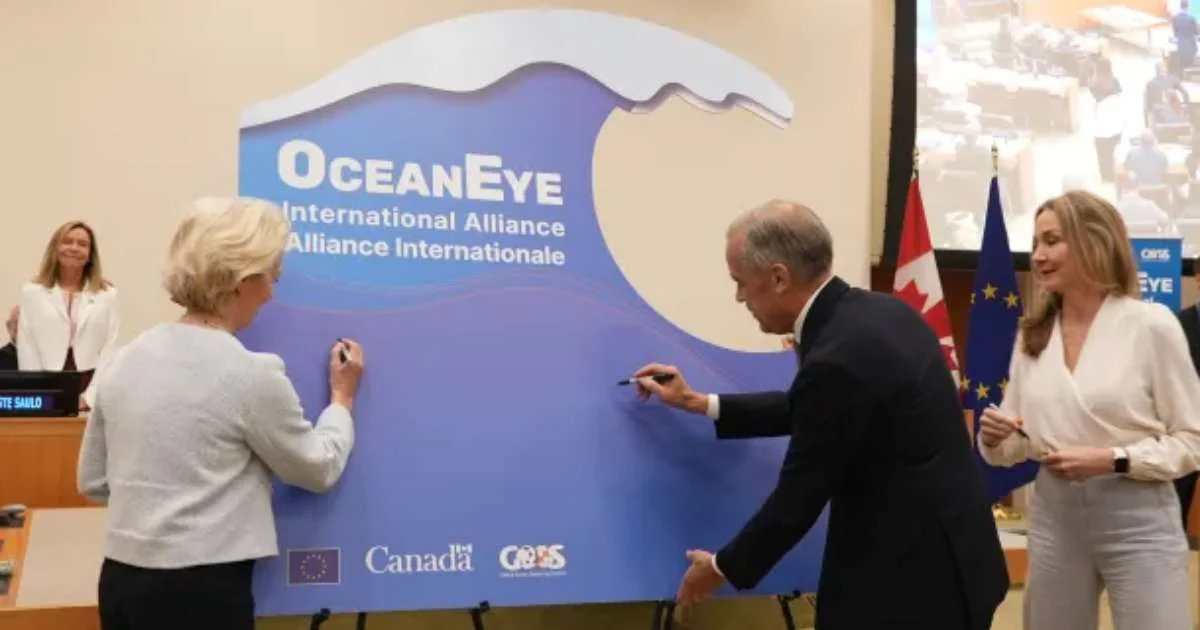
Co-hosted by European Commission President Ursula von der Leyen and Canadian Prime Minister Mark Carney, the OceanEye International Alliance for the Global Ocean Observing System (GOOS) was officially launched on Wednesday, 23 September 2026, during the high-level week of the 81st United Nations General Assembly (UNGA) in New York City.
The landmark alliance brings together the European Union and more than 30 country members across Europe, Africa, and the Americas. Operating in partnership with the Intergovernmental Oceanographic Commission of UNESCO (IOC-UNESCO) and the World Meteorological Organization (WMO), the initiative aims to stabilize an indispensable but chronically underfunded system that directly underpins global weather forecasting, maritime safety, and climate change data.
Deep Research Fact-Check & Key Metrics
The Funding Breakdown: Out of the initial €211 million global pool, the European Union provided a heavy seed injection by increasing its ocean observation funding with an additional €92 million. Meanwhile, Canada pledged CAD $82 million (€51.5 million) distributed over the next five years to specifically expand its year-round Arctic monitoring capabilities and deployment of autonomous underwater gliders.
The In-Kind Contributions: Beyond direct financial backing, partner nations are committing mission-critical assets, including specialized marine research vessels, advanced sensors, atmospheric drones, and high-performance data-processing facilities.
The Scale of the Network: The Global Ocean Observing System (GOOS) is a massive operational grid that already spans 64 countries, 17 distinct tracking networks, and 8,000 active ocean platforms, collectively outputting over 120,000 near-real-time observations daily.
Why This Alliance Matters Right Now
Despite its critical importance, GOOS has faced severe structural vulnerabilities due to a shortage of dependable, long-term government investments. Ocean monitoring has hit dangerous blind spots recently, most notably in the tropical Pacific, where no near-equatorial moored buoys are currently operating west of 165 degrees East. This leaves a massive blind spot in the western Pacific "warm pool"—the exact region that shapes global El Niño and La Niña cycles.
The €211 million secured by OceanEye will immediately go toward maintaining existing threatened infrastructure, funding the GOOS Secretariat, and scaling up observations in extreme environments like the polar regions and the deep ocean to improve early warnings for tropical cyclones and severe drought.