MALÉ — Minister of Fisheries, Agriculture and Ocean Resources Ahmed Shiyam has stated that the robust policies implemented by President Dr. Mohamed Muizzu to foster a research-based society will pave the way for the sustainable utilization of marine resources and the formulation of policies grounded in scientific findings and innovative ideas.
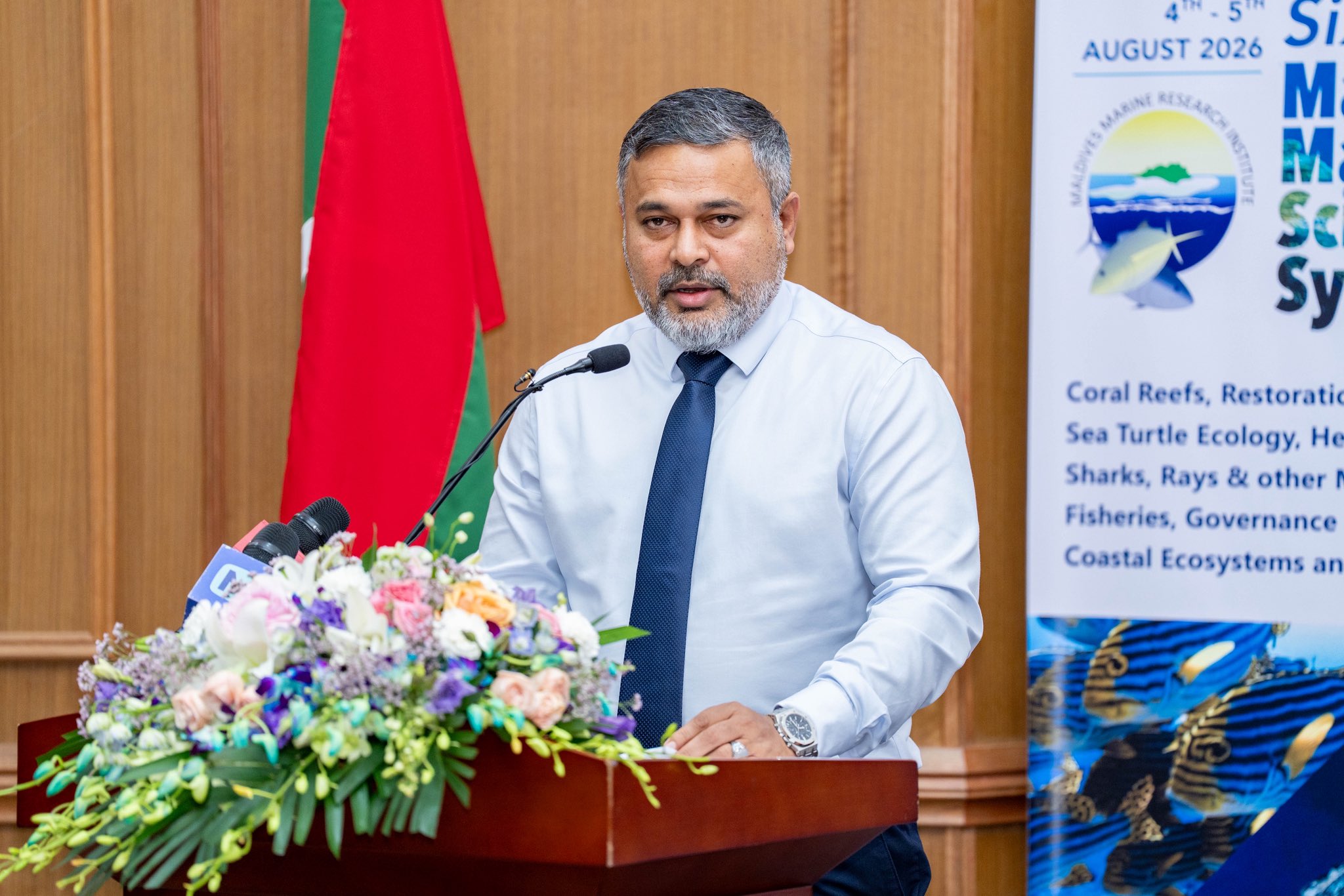
Speaking as the guest of honor at the inauguration of the Sixth Maldives Marine Science Symposium—organized biennially by the Maldives Marine Research Institute (MMRI) in partnership with the Maldives National University (MNU)—Minister Shiyam emphasized that the current administration places paramount importance on leveraging scientific discoveries to secure the full economic prosperity deserved by the Maldives. He noted that the academic works and insights shared during the two-day symposium will play a pivotal role in shaping policies for the sustainable management and conservation of the nation's marine wealth.
Capacity Building and Empowering the Next Generation
Highlighting the realities of a small island nation with a vast ocean territory, the Minister stressed the critical need to enhance local scientific capacity alongside enriching marine ecological knowledge. He expressed optimism that, through collaborations with international experts and institutions, marine research can be steered toward self-reliance for Maldivians. Such partnerships, he added, extend beyond mere knowledge acquisition; they serve as a powerful catalyst for nurturing the next generation of Maldivian scientists, researchers, and ocean stewards.
Concluding his address, Minister Shiyam remarked that today's investments in building skilled professionals within the scientific sector are essential to equipping future generations to safeguard the nation's greatest natural endowment: its marine environment.
Symposium Background and Overview
Established in 2016, the biennial Maldives Marine Science Symposium serves as the premier national platform for consolidating marine research, bridging academic institutions, independent researchers, NGOs, and government bodies to drive sustainable resource management and evidence-based policies.
The two-day event features 47 research presentations (32 oral and 15 poster presentations) spanning five core thematic categories:
Coral Reefs, Restoration and Climate Change
Fisheries, Governance and Society
Sea Turtles Ecology, Health and Conservation
Sharks, Rays and Other Marine Megafauna
Coastal Ecosystems and Seabirds
As the symposium continues over the next two days, participants remain optimistic that these comprehensive discussions will lay a solid foundation for the future safeguarding of the Maldivian marine ecosystem.