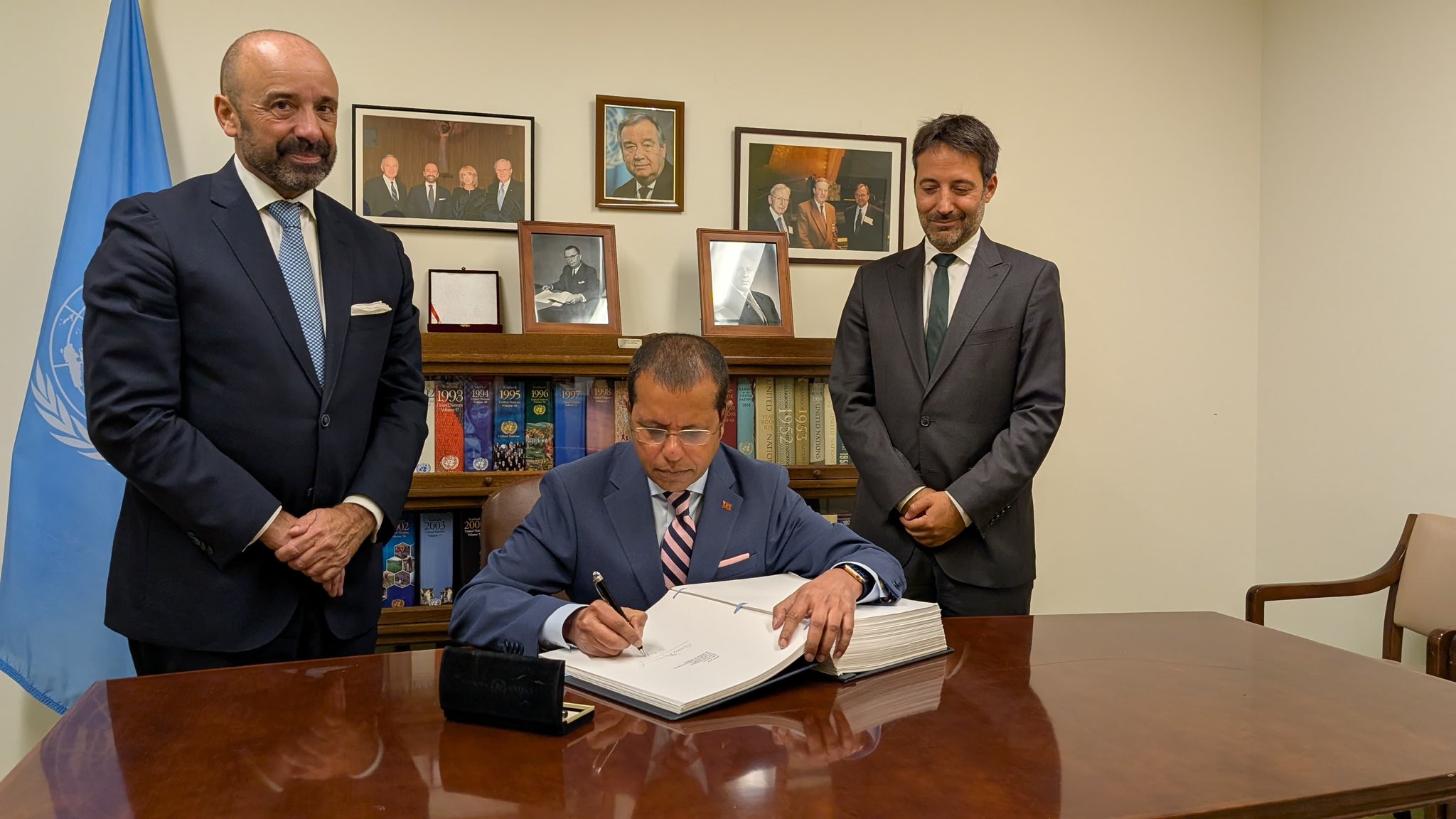
The Maldivian government has signed the United Nations Agreement on Biodiversity Beyond National Jurisdiction (BBNJ), also known as the High Seas Treaty.
The agreement, which concerns the conservation and sustainable use of marine biological diversity of areas beyond national jurisdiction, was signed on behalf of the Maldivian government by Ali Naseer, the Permanent Representative of the Maldives to the UN, at a ceremony held at the UN Headquarters this afternoon. The treaty is scheduled to be ratified during the 79th session of the UN General Assembly.
Following the signing of the treaty, Minister of Environment Thoriq Ibrahim stated that as a large ocean state, the Maldives views this as a historic achievement. He added that this is an important milestone achieved in the protection and sustainable use of marine life.
In 2015, the UN General Assembly decided to develop an international legally binding instrument on the conservation and sustainable use of marine biological diversity of areas beyond national jurisdiction. Following that decision, the text of the legal instrument was drafted between 2016 and 2023, and the aforementioned legal instrument was adopted as a treaty on June 19, 2023.
During a cabinet meeting held on February 11 this year, it was decided that it is important for the Maldives to sign and ratify this treaty. To proceed with this work, the government submitted it for parliamentary approval on February 29. After reviewing the matter, the Parliament approved the Maldives' participation in the treaty on May 13, 2024.
While protecting all natural resources within the maritime zones of the Maldives is a very high responsibility of the country, ensuring that areas beyond the maritime zones of the Maldives are protected and used sustainably is part of fulfilling that responsibility in protecting its maritime zones.
Accordingly, the signed treaty establishes procedures for protecting large areas of the ocean. In addition, the treaty includes provisions on sharing technical marine information, as well as formal measures for taking action in response to climate change. As all of these are important for protecting the benefits derived from the maritime zones of the Maldives, participating in this treaty will bring immense benefits to the Maldives.
Prior to the Maldives signing the treaty, a total of 91 countries had signed it, and a total of 8 countries had ratified it. The treaty, which is open for signature by all countries until September 20, 2025, will enter into force 120 days after the 60th country ratifies it.