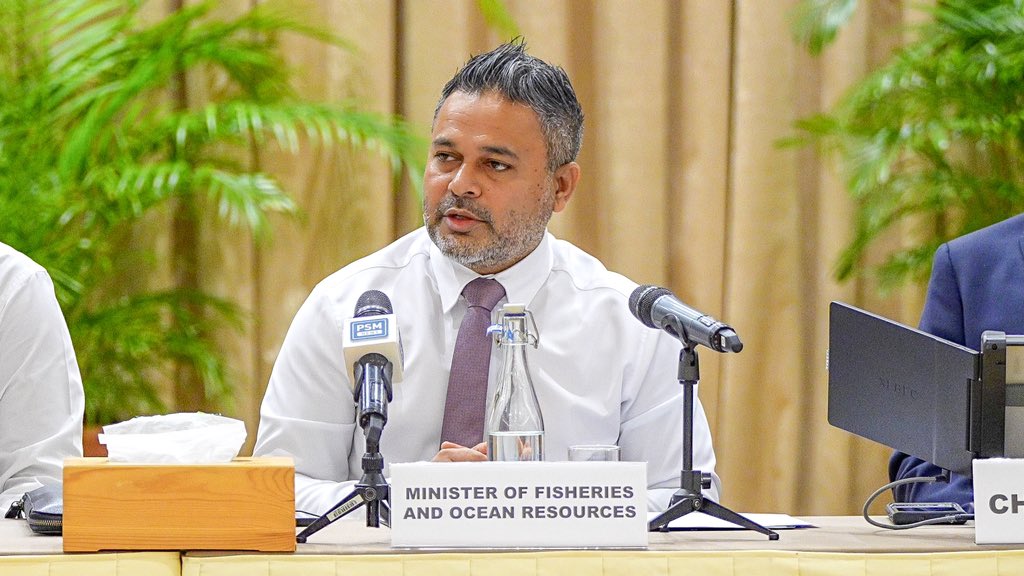
The 36th meeting of the G-16 Group of Like-Minded Coastal States, formed by Indian Ocean coastal nations, has commenced in the Maldives.
This meeting is held with the objective of discussing and reaching an agreement among member states regarding the resolution submitted to the Indian Ocean Tuna Commission (IOTC) on determining the maximum catch limits for tuna by various countries in the Indian Ocean. If an agreement is reached on this resolution during this meeting, it will be proposed for adoption at the IOTC annual meeting next year.
The meeting was inaugurated by Fisheries Minister Ahmed Shiyam. In his inaugural address, he highlighted that as the Maldives is one of the countries most reliant on Indian Ocean tuna fisheries, it is important to conduct these discussions in a way that minimizes the impact on the Maldivian economy, fisheries employment opportunities, and fishing families when determining the maximum catch limits for each country.
In addition to the Maldives, representatives from the fisheries ministries of Australia, Bangladesh, Comoros, Iran, Kenya, Malaysia, Mozambique, Sri Lanka, South Africa, Tanzania, and Thailand are participating in this two-day meeting. Representatives from the World Wide Fund for Nature (WWF), Sustainable Fisheries and Communities Trust (SFACT), and South West Indian Ocean Tuna are also participating as observers.
The G-16 is a group formed by like-minded coastal states among the IOTC member countries to work together. The main objective of this group is to coordinate among coastal states in planning and executing efforts through the IOTC to manage tuna fisheries in the Indian Ocean, and to make decisions with the participation of as many countries as possible.
Discussions have been ongoing for 14 years among IOTC member countries to establish an allocation regime to set catch limits in Indian Ocean tuna fisheries, in order to sustainably manage tuna and tuna-like species in the Indian Ocean.