Fisheries Minister Ahmed Shiyam has stated that voices must be raised in international arenas regarding the development of and investment in small-scale fisheries.
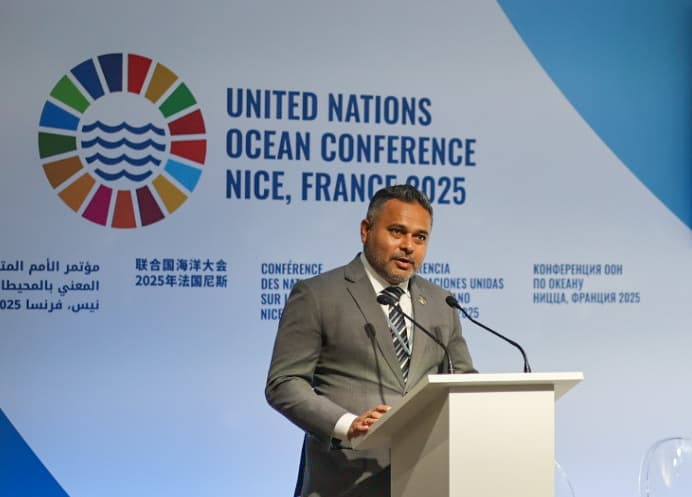
Minister Shiyam made these remarks at a special session held to share ongoing efforts to sustainably plan, operate, and manage small-scale fisheries, and to discuss ways to empower those active in the sector. This meeting was a side event initiated by the Maldives at the 3rd United Nations Ocean Conference.
During this session, governments, as well as regional and international bodies, shared case studies on their efforts to sustainably plan, operate, and manage small-scale fisheries. The Fisheries Ministry stated that, in light of these experiences, discussions were held on measures that other countries could also adopt.
Speaking at the session, Fisheries Minister Ahmed Shiyam stated that voices must be raised in international arenas regarding the development and investment in small-scale fisheries. However, he noted that discussions on small-scale fisheries often occur only on the margins of such international dialogues, and that those engaged in small-scale fisheries are lagging far behind in terms of policies, investments, and innovation. The Minister stated that this needs to change. He also highlighted the efforts being made by the Maldives to develop its fisheries through science and technology.
Indonesia's Director General of Capture Fisheries, Latief, who participated in the meeting, shared how fishing is conducted in neighboring Indonesia. He discussed the country's quota-based fishing system and how they are advancing the blue economy by increasing stakeholder participation and collaborating with international partners. He stated that these efforts are driven by science and built upon strong, transparent systems.
Dr. Hussain Sinan, Director General of the Ministry of Fisheries and Ocean Resources, highlighted the state's efforts in planning and managing the Maldives' tuna fishery during the session. In his speech, Dr. Sinan noted the high priority given to sustainable fishing principles and equity in carrying out these efforts. He also highlighted the ongoing work to facilitate access to international fish markets and to manage the fishery in a way that ensures the benefits of small-scale fisheries are distributed throughout the entire community.
Highlighting the importance of fisheries statistics, Dr. Sinan stated that significant work is currently underway to digitize the fisheries data that the Maldives has been collecting and maintaining since the 1950s. Dr. Sinan noted that this is a crucial step towards the sustainable management of the responsible tuna fishery conducted in the Maldives.
Speaking at the meeting, marine biologist Dr. Lilian J. Ibengwe shared Tanzania's experience with small-scale fisheries. Tanzania is the first country in the world to formulate a National Plan of Action for small-scale fisheries. Dr. Lilian noted that this plan has ensured stakeholder participation in formulating fisheries policies and managing the fisheries, thereby empowering them. She also pointed out that the plan serves as a catalyst for fully implementing the Small-Scale Fisheries Guidelines prepared by the Food and Agriculture Organization (FAO).
In addition to countries, regional organizations also participated in this meeting initiated by the Maldives. Dr. Krishnan, Director of the Bay of Bengal Programme – Inter-Governmental Organisation (BOBP-IGO), shared potential actions to develop and empower small-scale fisheries at the regional level. He also announced that assistance would be provided to formulate national action plans for small-scale fisheries in all BOBP-IGO member countries.
Dr. Manuel Barange, Assistant Director-General of the Food and Agriculture Organization (FAO), also spoke at the session. In his remarks, Dr. Barange highlighted the resources developed by the FAO to promote the advancement and well-being of fishing communities. He also gave assurances of the FAO's full support for the efforts undertaken by BOBP-IGO to formulate national action plans for small-scale fisheries.