Director General of the Fisheries Ministry Hussain Sinan has stated that the Biodiversity Beyond National Jurisdiction (BBNJ) agreement is an opportunity to fill the crucial gap in protecting marine biodiversity.
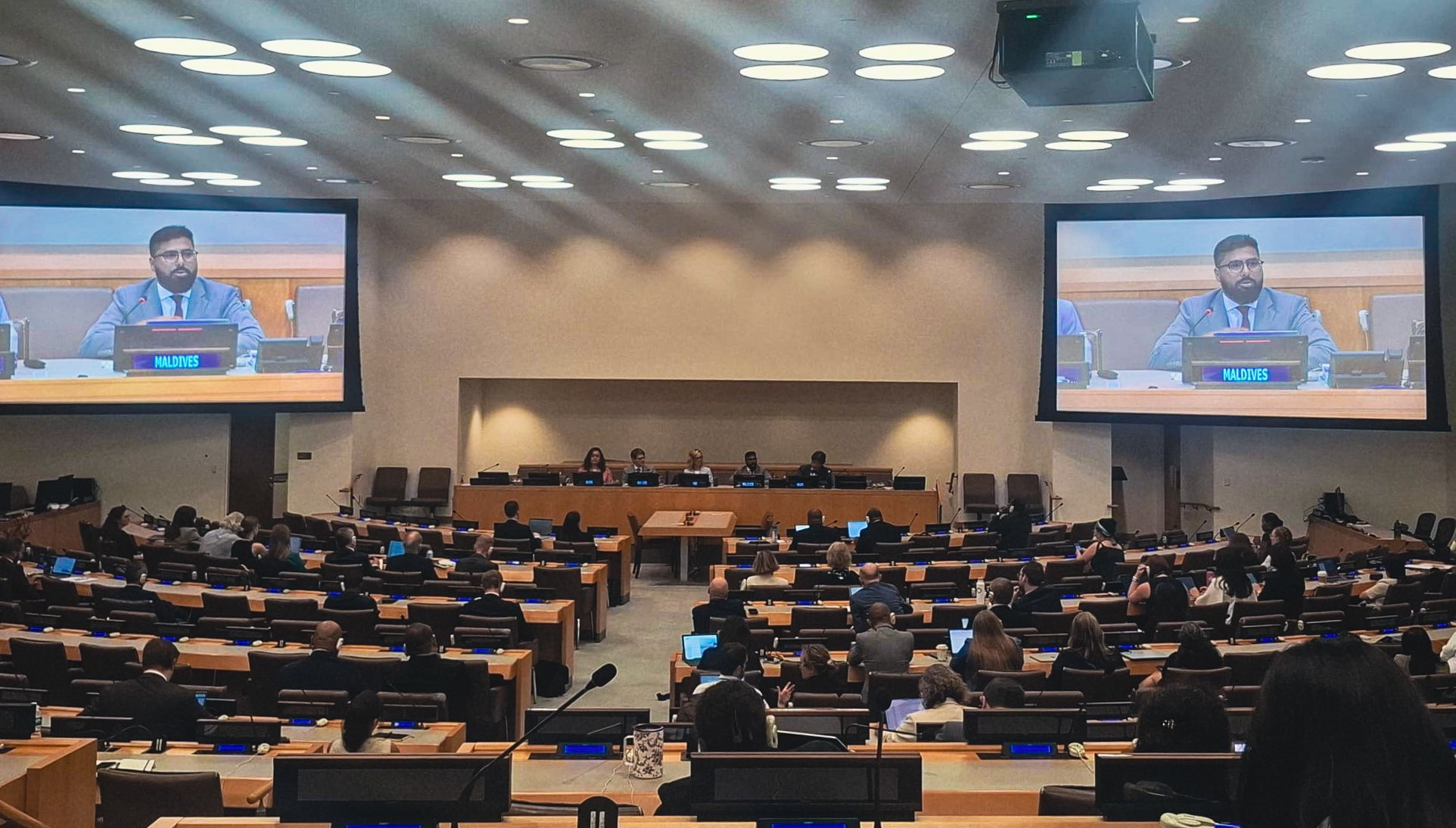
Sinan made these remarks while speaking at a panel discussion held on the sidelines of the second session of the Preparatory Commission, which is taking place in New York, USA, from the 18th to the 29th of this month, in preparation for the entry into force of the BBNJ treaty. The event, held yesterday on the margins of "BBNJ PrepCom 2", was aimed at understanding the intersection between BBNJ and fisheries. Participating as a panelist, Sinan highlighted the extent to which Maldivian communities are connected to the ocean, and how the health of the ocean is intertwined with the survival of our communities.
In his speech, Sinan described the ocean not merely as something that protects or sustains these communities, but as a part of life for the Maldives and many Small Island Developing States (SIDS).
"The ocean feeds us, provides us with jobs, and facilitates our survival. It is our culture and our life. And it is what connects us to the rest of the world," Sinan said.
To prove this point, Sinan noted that one in every five people in the Maldives is engaged in fishing, with fishermen making up 20 percent of the country's workforce. Furthermore, with 98 percent of the Maldives' exports consisting of fish, Sinan stated that tuna is not just a source of income.
"Fish is our breakfast, lunch, and dinner. We consume 154 kilograms of tuna per person annually. So, that shows the extent to which we are connected to the ocean, and how our identity is formed and developed from the ocean. And that is the reason we are always at the forefront of ocean governance, whether it is in protecting it or using it sustainably," Sinan said.
Referring to the efforts made by the Maldives in the international arena to protect the ocean, Sinan stated that since the Maldives joined the Indian Ocean Tuna Commission in 2011, it has submitted 52 proposals related to the protection and management of marine resources. These include proposals on conservation measures, bycatch, protection of sharks and rays, and setting catch limits for all types of tuna in the Indian Ocean.
Stating that the Maldives has also contributed to science as a member of the Indian Ocean Tuna Commission, Sinan said that this essential need to keep the ocean healthy and sustain our lives and livelihoods was the reason that paved the way for the Maldives to be one of the first few countries to ratify the BBNJ treaty. He also stated that he views BBNJ as an opportunity to fill the crucial gap in protecting marine biodiversity.
In his speech, Sinan also highlighted the various opportunities provided by the BBNJ agreement. These include strengthening cooperation among different mechanisms, frameworks, and institutions, including RFMOs and multilateral environmental agreements; ensuring that SIDS have the opportunity to fully and meaningfully participate and advocate, rather than just having a seat at the table; and empowering developing countries by increasing their capacity and facilitating them to work with global experts. In addition, Sinan said that implementing the BBNJ treaty based on the principles of cooperation, equity, and genuine capacity building will ensure that its benefits are felt by everyone, especially the communities most closely connected to the ocean.
"The reality we all have to honestly accept is that the BBNJ treaty is coming into existence in an area where several regional fisheries management organizations with different mandates are already operating. This might seem like a duplication. However, if we can properly establish mechanisms for cooperation and coordination, we see this as an opportunity," Sinan said.
In his speech, Sinan expressed concern that the implementation-level officials of the countries that have to implement BBNJ are not adequately aware of its details. He also noted that governments have not always spoken with one voice in the areas of fisheries and biodiversity, and even within governments themselves, fisheries and environmental agencies do not speak with one voice. Therefore, noting that the PrepCom-2 session is taking place at a time when there is no such coordination mechanism, he said there must be genuine participation from the STB, through the Secretariat, and up to the governance mechanisms of the COP. He also said that priority must be given to cooperation mechanisms with RFMOs, and that it is very important to provide the capacity building and information exchange opportunities currently being carried out by many RFMOs.
"I believe WCPFC and IOTC are doing this. The Secretariat is doing notable work on capacity building, including data collection systems and statistical information. Therefore, to minimize duplication, it is important to build on those already established systems. It is important that the signals we provide or give from this PrepCom regarding cooperation and collaboration—from hosting the Secretariat to compliance mechanisms and cooperation mechanisms—give a clear signal that IFBs or RFMOs are not excluded, and that they are included in this work," Sinan said.
Sinan said that looking at the situation in the Maldives, participating in scientific work increases the capacity of those involved in it, which in turn empowers the Maldivian government to increase its capacity. He added that if BBNJ is implemented equitably, its benefits will be felt by small island states like the Maldives.
"Fisheries and biodiversity are not two separate worlds. We are talking about one ocean. If you approach the BBNJ agreement with cooperation, equity, and genuine capacity building, it will benefit us all. Especially countries like ours," Sinan said.
Regional and global fisheries experts participated in this event. The event explored the impacts of the BBNJ agreement on fisheries, how fisheries are integrated into the implementation of this agreement, and the reasons why strong cooperation between the BBNJ agreement and fisheries is important. In addition to Sinan, the panelists for this event included Rhea Moss-Christian, Executive Director of WCPFC; Adam Berry from New Zealand's Ministry of Primary Industries and Chair of the FAO Committee on Fisheries; and Ivan Lopez, Chair of the International Coalition of Fisheries Associations.
The panel was inaugurated by Alice McDonald, Senior Fisheries Officer at FAO and Secretary of the Committee on Fisheries. The panel was moderated by Darius Campbell, Chair of the Regional Fishery Body Secretariats' Network.